The Darryn Peterson Paradox: Kansas Basketball’s Battle Between Star Power and Team Synergy in the NIL Era.
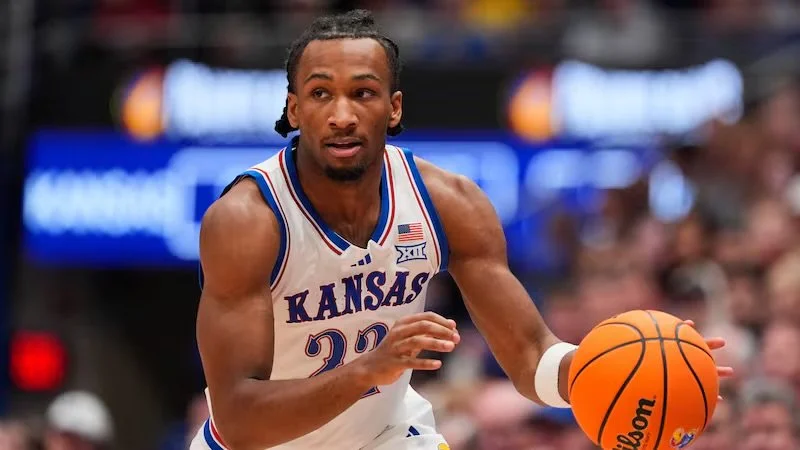
Kansas men’s basketball has long been synonymous with excellence—a blue-blood program with six national titles, a Hall of Fame coach in Bill Self, and a pipeline to the NBA. But in the post-NIL era, where Name, Image, and Likeness deals have reshaped recruiting and roster construction, even dynasties are being forced to adapt in real time.
Enter Darryn Peterson.
The freshman phenom—projected by many as a potential No. 1 pick in the 2026 NBA Draft—was expected to restore Kansas to unquestioned dominance. Instead, his presence has surfaced a familiar and uncomfortable tension: the disruptive gravity of a one-and-done superstar on a team trying to build rhythm, identity, and cohesion.
Peterson is undeniably the most talented player on the roster. And yet, Kansas has often looked more connected without him. That’s a problem.
A Familiar NIL-Era Pattern
This isn’t Kansas’s first brush with NIL-era friction.
In 2023, Hunter Dickinson transferred from Michigan amid major hype and significant NIL attention. On paper, it looked like a perfect marriage: an All-American big paired with Bill Self’s system. In reality, the fit was uneven. The offense shifted. Expectations clashed. Chemistry reportedly suffered.
The results told the story. An early NCAA Tournament exit in 2024, followed by an injury-plagued and underwhelming 2024–25 season. Talent was never the issue. Integration was.
That experience now feels like a warning shot.
Peterson’s Brilliance—and the Cost of It
Fast-forward to January 2026.
Peterson, a 6-5 guard with an NBA-ready body and effortless scoring ability, flashes elite potential every time he’s on the floor. A career-high 32 points in an overtime comeback against TCU. Twenty-six points in just 23 minutes versus UCF. His per-minute numbers scream pro. But availability has been inconsistent.
A preseason hamstring strain sidelined him for seven games in November. Since returning, recurring cramping issues have kept him on a minutes restriction or out entirely. He’s appeared in only six games all season, often with limited minutes.
And when he’s unavailable, something interesting happens: Kansas plays freer.
During Peterson’s absences, the Jayhawks went 3–0 at the Players Era Festival in Las Vegas, including a comeback win over Tennessee. Roles clarified. Confidence grew. Players like Flory Bidunga, Tre White, and especially Melvin Council Jr. stepped forward. Council erupted for 36 points and nine threes in an overtime win over NC State—another game where Peterson was limited.
These stretches revealed something uncomfortable: Kansas often looks more fluid without its most talented player.
The TCU Game: A Perfect Snapshot of the Paradox
The January 6 overtime win over TCU encapsulated everything.
Statistically, Peterson was the hero: 32 points, clutch free throws, the foul drawn on a three with 1.7 seconds left to force overtime. But beneath the box score was chaos.
Peterson spent long stretches on the bench amid constant broadcast focus on his cramping and injury status. With 2:30 left in regulation—during a crucial comeback—he looked to the bench and subbed himself out mid-play, leading to a turnover. He returned only for the final possession, delivered the clutch moment, then did not play a single second of overtime.
Kansas won anyway. It was cinematic. And deeply destabilizing. This is what disruption looks like—not through ego or selfishness, but through uncertainty. The team never quite knows who’s available, for how long, or under what conditions.
Kansas Head Coach Bill Self on Darryn Peterson after the TCU matchup.
The Deeper Issue: This Isn’t Just Physical
Peterson’s cramping and frequent exits don’t exist in a vacuum.
When elite athletes experience legitimate injuries at pivotal moments in their development—especially right before their professional future comes into focus—it often creates a heightened fear of re-injury. That fear doesn’t always show up as anxiety or hesitation. Sometimes it shows up as hyper-vigilance, panic responses, and an inability to self-regulate physical sensations.
Cramping becomes catastrophic. Tightness becomes danger. The nervous system stays on high alert. From the outside, it can look like fragility; internally, it’s survival mode. This is where many elite programs still miss the mark.
Complicating matters further is that much of this no longer appears fully within Bill Self’s control.
In press conferences, Self has alluded to shifting daily statuses—cramping one day, illness the next, hamstring tightness after that—and emphasized that availability decisions involve external input. Peterson’s independent team appears to have significant influence over when and how much he plays, making true system integration nearly impossible.
That’s NIL reality at full volume: multiple stakeholders, competing priorities, and a head coach left managing uncertainty instead of rhythm. Teammates guess. Lineups shift. And cohesion never fully settles.
Where My Work Fits in a Situation Like Peterson’s
What Peterson appears to be struggling with isn’t toughness or commitment—it’s regulation.
High-stakes athletes often carry immense somatic load: physical stress, emotional pressure, future uncertainty, and the constant awareness that one wrong move could cost them everything. When that load isn’t processed or regulated, the body becomes reactive. Sensations escalate. Decision-making narrows. The athlete loses access to rhythm and trust.
This is exactly where somatic work—yoga, breathwork, mindfulness, and brainspotting interventions—can be transformative.
Not as recovery fluff or mental toughness rhetoric—but as a way to restore nervous system regulation, so the body isn’t constantly operating in threat mode. It’s a way to reduce fear responses tied to injury, improve interoception (the ability to accurately interpret bodily signals), and rebuild trust between athlete and body. And ultimately, a way to support what teams actually need: availability, consistency, and real integration—not just talent on paper.
When athletes learn how to stay with sensation without panic, cramping stops being an emergency. Tightness becomes information, not a threat. And coaches regain something invaluable: predictability. Without this layer of support, athletes like Peterson are left to manage immense pressure alone—often with advisors focused more on preservation than integration.
The Bigger Question Kansas Has to Answer
Peterson isn’t the villain here. He’s a byproduct of a system that forces NBA-ready players into a college environment that no longer fits them cleanly. But Kansas still has a choice and a job to do.
Can they harness his talent without letting it fracture the collective?
Can they support the human nervous system underneath the NBA projection?
Or does chasing star power continue to erode culture and cohesion?
If Kansas figures out Peterson’s holistic health—and he becomes a reliably available, regulated presence—a deep March run is absolutely possible. Ironically, if they don’t figure it out and choose clarity without him, this team is still capable of making a run.
What’s killing them isn’t talent. It’s limbo—for the team and for Peterson’s career trajectory alike. These intrapersonal struggles don’t disappear at the next level; under greater scrutiny and higher stakes, they only intensify.
One way or another, Bill Self has to resolve it—because even the most stable legacies can’t survive prolonged uncertainty in the NIL era.
As a Lawrence native, I certainly hope they figure it out soon.
—
If you’re an athletic director, head coach, assistant coach, strength coach, sport psychologist, or anyone in a college or professional program who needs help understanding and implementing this layer of training and development, reach out. Past injuries, immense pressure, and the fear of losing everything don’t have to become chronic pathologies that limit potential. They can be leveraged as powerful teaching moments that unlock deeper consistency, trust, and peak performance. Your players deserve support that goes beyond the court.