The Loneliest Job in the NFL: Younghoe Koo and the Inner Violence of Kicking.
There is no position in professional sports that so perfectly disguises its psychological brutality as the placekicker. From the outside, the job appears simple—almost serene. A few rehearsed steps. A clean swing. Six seconds of interruption inside a three-hour game. No collisions. No chaos. No obvious danger. And yet, beneath that illusion of simplicity lies perhaps the most neurologically punishing role in team sports. The kicker is not embedded in the rhythm of the game; he is summoned into it like a verdict. Everyone else lives inside flow. The kicker lives inside anticipation.
Few careers expose that reality more starkly than that of Younghoe Koo.
Koo’s story reads like a parable of modern performance culture—how quickly certainty becomes doubt, how fragile trust between body and mind can be, and how unforgiving the NFL is once that trust is disrupted. Born in South Korea, raised in the United States, a soccer player turned late-entry football prospect, Koo arrived in the league without the safety net afforded to blue-chip specialists. Undrafted. Briefly with the Chargers. Cut within weeks. Out of the NFL entirely. For most players, that is where the story quietly ends.
Instead, Koo rebuilt himself in the now-defunct Alliance of American Football, where he became a symbol of quiet reliability once again—perfect on every kick before the league itself collapsed beneath him. When the Atlanta Falcons signed him in 2019, it felt less like a gamble and more like an afterthought. What followed was one of the most efficient five-year kicking runs the league has seen in the last decade. Nearly automatic inside 50. Exceptionally dangerous from distance. Trusted in late-game moments. Trusted when drives stalled. Trusted when chaos arrived. In a franchise defined by instability, Koo became a stabilizer.
From 2019 through 2023, he averaged just under 91 percent on field goals, often under conditions that skewed heavily toward high-leverage attempts. Atlanta’s offensive inconsistency forced him into more long kicks than most specialists ever see. Fewer extra points. More 45- and 50-plus yarders. More moments where the entire emotional gravity of the game funneled into one isolated rep. And he thrived. He earned a long-term extension. He became a fan favorite. He became, by consensus, one of the most reliable kickers in football.
Then the body broke its promise.
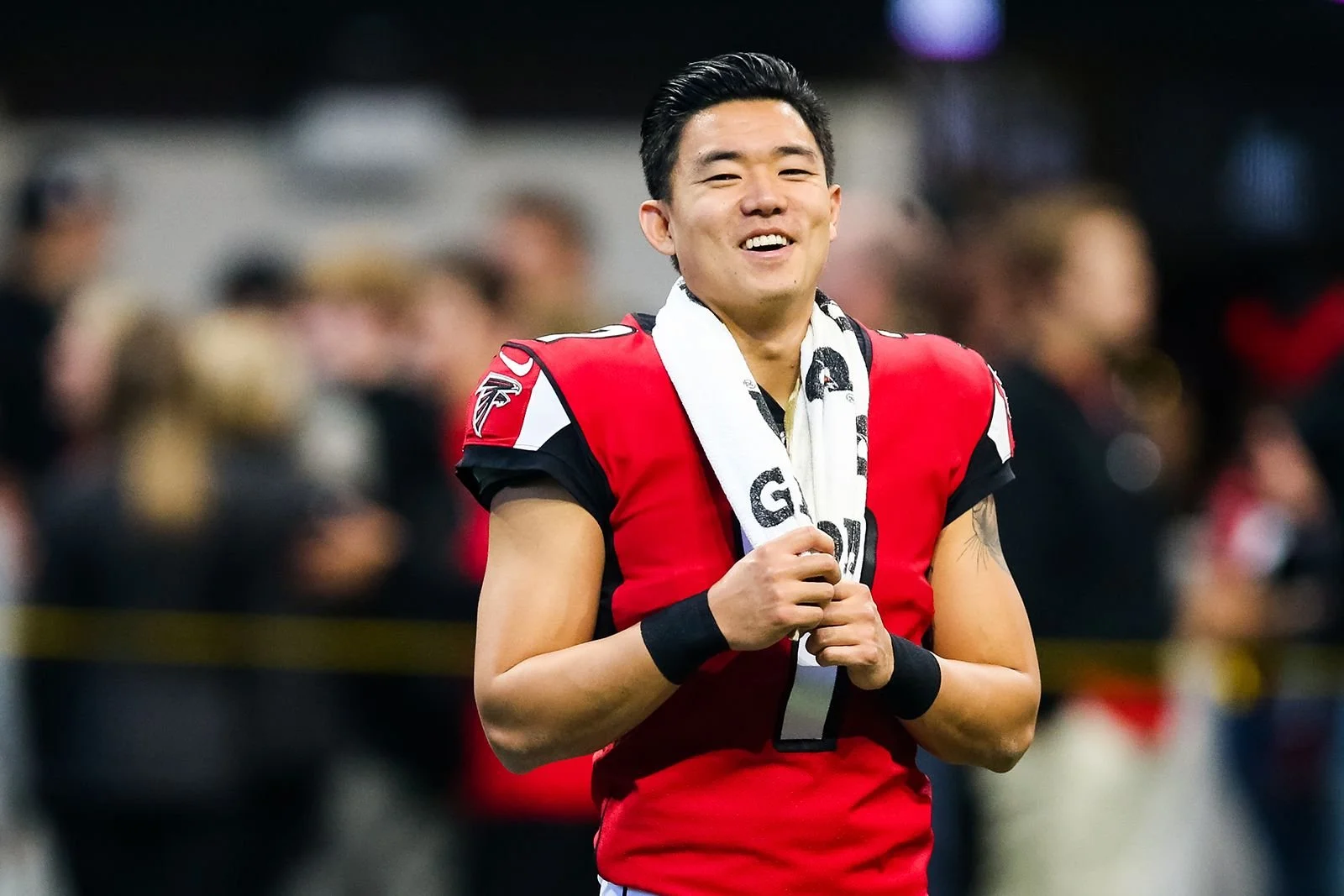
When the Body Learns Threat
In 2024, a nagging right hip injury disrupted the first layer of his trust with movement. Subtle changes in approach speed. Slightly altered plant angles. Diminished kickoff distance. The wrapped-in-tape season that kickers quietly try to survive without complaint. By year’s end, Koo had recorded the worst statistical season of his career—nine misses, a number that would have been unthinkable two years earlier. Atlanta missed the postseason. Two overtime losses hung in the balance. Public confidence quietly frayed.
What injury reports never capture is that the nervous system does not experience injury as a mechanical malfunction. It experiences it as threat. When the body fails in a high-stakes environment, it learns something about danger that does not automatically resolve when medical clearance is granted. Even when strength returns, even when range of motion normalizes, the memory of risk often remains active beneath conscious oversight—altering sequencing, timing, and subconscious trust.
By the start of 2025, Koo was considered physically healed. Neurologically, return is never binary.
The unraveling came quickly. A late missed field goal in Week 1 cost Atlanta a game. The leash shortened instantly. He was benched. Then released. In the NFL, a kicker’s past is erased by a single present-tense miss. There is no sentimental runway for redistribution of confidence. There is no allowance for nervous system recovery. There is only outcome.
Koo landed with the New York Giants and, on paper, steadied himself. In his first games, he looked reliable again. The numbers suggested normalcy. But paper rarely tells the entire neurological story.
The Monday Night Whiff
New York Giants kicker Younghoe Koo’s alarming miss against the New England Patriots on Monday night. Footage via NFL.
Then came Monday night against the New England Patriots—a sequence so unusual it defied categorization. A disrupted hold. An aborted swing mid-motion. A slipping plant foot. A full whiff of the ball, not as a miss or a block, but as a breakdown of timing itself. By the time social media finished processing the clip, it had already been converted into spectacle, stripped of context, flattened into a meme.
But what unfolded in those seconds was not merely a technical malfunction. It was the visible imprint of a nervous system under threat. A system caught between conscious correction and subconscious hesitation. A system still negotiating its relationship with uncertainty.
A Position Built on Anticipation
This is where the kicking position becomes singularly cruel. Every other player on the field is buffered by rhythm and contact. A quarterback throws an interception and touches the ball again on the next series. A corner gives up a touchdown and lines up forty seconds later. A lineman loses a rep and immediately collides again. Their nervous systems discharge through motion. Stress moves through the body. The system recalibrates in real time.
The kicker does not get that privilege. He waits. He anticipates. He rehearses internally without release. Then he is summoned into moments that often carry the full emotional and numerical weight of the game. He succeeds alone. He fails alone. And if he fails, he may not touch the field again for a week—carrying unresolved threat inside his body without any organismic completion.
This is why kicking is not fundamentally a mechanics problem or a leg-strength problem. It is a nervous-system problem. And once injury enters that equation, the psychological load intensifies exponentially.
Statistically, the injury split in Koo’s career is stark. From 2019 through 2023, before the hip injury, he averaged approximately 90.8 percent on field goals. From 2024 through 2025, that number fell to roughly 75.3 percent—a collapse that borders on career-altering at the NFL level. But the deeper story emerges when pressure is weighted. Pre-injury, Koo was elite from 50-plus yards. Post-injury, his long-range reliability fell sharply. The kicks carrying the highest neurological exposure—the longest distances, the narrowest margins, the noisiest stadium pressure—became the least stable.
That pattern is not unique to Koo. It is typical of injury-impacted specialists. Strength comes back first. Confidence returns last. And confidence, in the neurological sense, is not belief—it is trust in sequence. Trust in unconscious timing. Trust that the body will do what it did before it learned something about danger.
This is precisely where most organizations fail their kickers.
What Actually Restores Trust
The NFL pours billions into strength, speed, biomechanical output, and recovery technology. Yet the most exposed athletes on the field—specialists whose entire careers hinge on regulating threat in isolation—are often given nothing more than verbal encouragement and mechanical adjustment when things unravel. The body is expected to relearn trust through cognition alone. Biology, however, does not work that way.
This is where somatic disciplines fundamentally shift the equation.
Breathwork restores rhythm to a nervous system trapped in anticipatory arousal. It reintroduces controllable cadence in a job defined by waiting. Mindfulness redirects attention from catastrophic projection back into present-moment sensation, where trust can be rebuilt at a physiological level. Performance yoga teaches the body how to move fluidly under internal pressure instead of bracing against it. And brainspotting—perhaps the most misunderstood yet profoundly effective of these modalities—allows the brain to complete unfinished threat responses encoded during injury and high-stress failures without forcing cognitive re-exposure.
When kickers struggle after injury, it is rarely because the leg is weak. It is because the system no longer feels safe organizing maximal output at maximal stakes. The body remembers what the mind insists it has moved past. Until that memory is processed through the nervous system itself, mechanical work alone simply lays new layers over unresolved threat.
The cruelty of the kicker’s profession is not simply that failure is public. It is that redemption is delayed. There is no volume of additional reps to dilute the weight of a miss. There is only anticipation. And anticipation, when left untreated, becomes anxiety. Anxiety becomes hyper-vigilance. Hyper-vigilance becomes timing disruption. Timing disruption becomes another miss. And the cycle tightens.
Younghoe Koo did not suddenly forget how to kick a football. His system learned something about danger during injury, scrutiny, and public collapse, and it has not yet been fully guided back to safety. That is not weakness. That is biology.
His career is not a cautionary tale of failure. It is a clinical case study in what happens when the most psychologically vulnerable position in football is expected to heal in the same way linemen do. It cannot. The demands are different. The exposures are different. The consequences of error live longer in the body.
Until the league treats nervous system regulation with the same seriousness it gives muscle and mechanics, stories like Koo’s will continue to repeat. Not because kickers lack toughness. But because their job requires a level of inner containment that no human system can indefinitely maintain without structured support.
The kicker’s work is not violent in the way football usually is. There are no collisions. No helmets snapping together. No bone-rattling hits. And yet, few positions absorb more quiet violence internally. The violence of waiting. The violence of isolated consequence. The violence of being remembered for a single second more than for six seasons of certainty.
Younghoe Koo is not broken. He is exposed. And what his career now illuminates is not simply the volatility of the kicker’s job—but the urgent need to finally address the biological reality beneath it.
—
Younghoe Koo is living proof that kicking isn’t about leg strength nearly as much as it is about regulated threat inside a dysregulated nervous system. Until the NFL treats that reality with the same rigor it applies to biomechanics and GPS data, we’ll keep watching good kickers mysteriously “lose it” the moment injury or pressure rewires their subconscious timing. It doesn’t have to be this way. I’ve spent years helping athletes rebuild that deepest layer of trust through breathwork, somatic processing, brainspotting, and movement re-patterning that actually completes the old stress cycles instead of layering new techniques on top of them.
If you’re an athlete, coach, or parent who’s tired of watching talent get hijacked by an unhealed nervous system, reach out. The tools exist. The body can feel safe again. And the difference between a career-ending spiral and a full return often comes down to someone finally addressing what the stat sheet can’t see.
Metta,
Drewsome.